
Planning the perfect campervan route across Europe is one of those things that sounds simple until you actually open a map and realise you have forty countries, thousands of wild camping spots, and zero idea where to start. This guide cuts through the noise. Whether you want Norwegian fjords, Balkan coastlines, or mountain passes that most tourists never find, you'll discover the ten best routes for a campervan road trip in Europe, with real distances, practical tips, and honest advice about what makes each one worth your time. From finding the best off-road campervan trails to understanding where wild camping is legal, this article covers everything you need to plan a trip you'll actually remember.

Why Europe Is the World's Best Campervan Destination
No other continent packs this much variety into such a manageable driving area. You can go from beach to mountain, from desert to glacier, all within a few days of driving. The road infrastructure in Western and Northern Europe is excellent, while Eastern Europe and the Balkans offer raw, unpaved adventure that rewards a proper off-road campervan setup.
The best campervan routes in Europe share a few things in common. They mix driving days with proper rest days. They include at least some sections of unpaved track. And they take you somewhere that feels genuinely remote, even if you're only a few hours from a major city.
At Nomad Camper, we've built our rental campervan specifically for routes like these. The MAN TGE 3.140 with pneumatic suspension handles mountain passes, beach tracks, and forest roads equally well. And because it comes with Starlink Mini built in, you get 50 to 200 Mbps internet anywhere on the continent, which matters a lot when you're working remotely from a campervan or just want to stream a film in a Croatian national park.
- Europe has over 30 countries accessible without border crossing delays for EU nationals
- Wild camping is legal or tolerated in Norway, Scotland, Finland, and parts of the Balkans
- Driving distances between major highlights are often just 200 to 400 km
- Seasonal variety is extreme: snow roads in winter, empty beaches in shoulder season
Key insight: The biggest mistake first-time campervan travellers make is covering too much ground too fast. Pick one region, go deep, and leave the other nine routes for future trips.
Norway: The Atlantic Road and Lofoten Islands
If there's one campervan route in Europe that belongs on every list, it's Norway. The Atlantic Road, connecting Kristiansund and Molde via a series of bridges over open sea, is genuinely unlike anything else in the world. Pair it with the Lofoten Islands and you have two to three weeks of driving that will ruin you for any other landscape.
Route overview
Start in Bergen, drive north through Ålesund, cross the Atlantic Road, continue to Geiranger, then take the ferry to Lofoten. Return south via the E6 through Trondheim. Total distance: roughly 3,000 km with a week in Lofoten.
- Best season: June to August for midnight sun, September for quieter roads and autumn colour
- Wild camping: fully legal under Allemannsretten (the right to roam)
- Road surface: mostly tarmac, some gravel tracks to beach spots require clearance
- Ferry costs: budget 60 to 120 EUR for the mainland-to-Lofoten crossing
Norway is expensive for fuel and food, but wild camping is completely free and the scenery compensates for everything. A camper 4x4 setup really earns its keep here when you want to park directly on a beach or reach a viewpoint that tour buses can't access.
Scotland: The North Coast 500
The NC500 is 516 miles of single-track roads, sea lochs, white sand beaches, and ancient castles around the northern coast of Scotland. It's been called Europe's answer to Route 66, and while that comparison undersells its raw wildness, the point stands: this is one of the most dramatic road trips on the continent.
Start and finish in Inverness. The route loops through Torridon, Cape Wrath, Durness, John o'Groats, and the Flow Country. Budget ten to fourteen days if you want to stop properly rather than just drive.
- Wild camping: legal under the Land Reform (Scotland) Act 2003
- Road surface: mainly single-track tarmac with passing places
- Best season: May to September, though April can be stunning and quieter
- Fuel stops: plan ahead, some stretches have no petrol for 80 to 100 km
The NC500 works well as a first-time campervan route in Europe because Scotland is easy to navigate, English-speaking, and has a well-developed wild camping culture. It also combines well with a ferry crossing from Bergen, making a Norway-Scotland double route possible in three to four weeks.
The Balkans: Montenegro, Albania, and Northern Macedonia
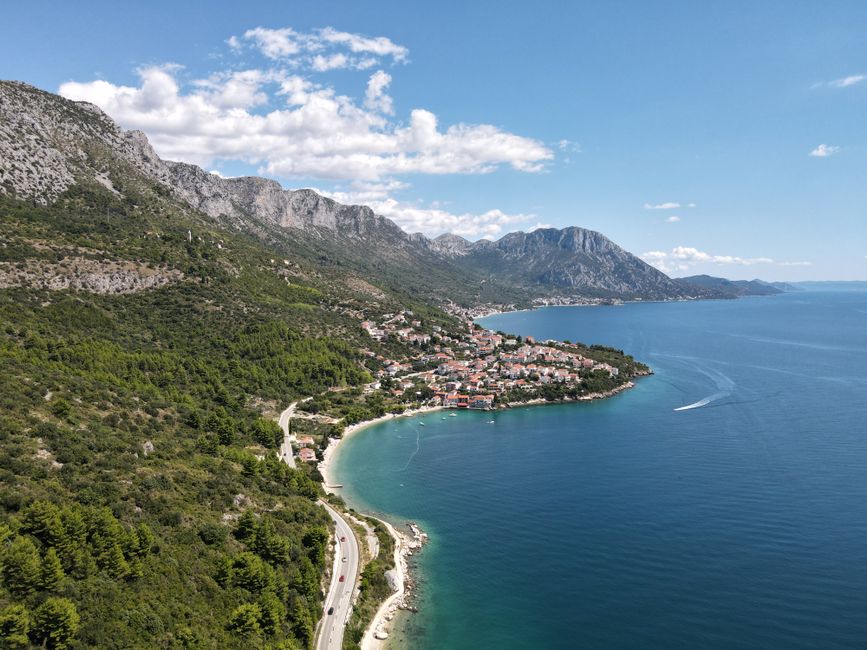
The Balkans are where Europe's campervan scene is heading in 2026. Montenegro alone has more dramatic coastline per kilometre than anywhere in Croatia, with a fraction of the tourist traffic. Albania is even more extreme: near-empty beaches, mountain roads that feel like they belong in another decade, and some of the most hospitable locals you'll encounter anywhere.
Recommended loop
- Enter Montenegro via Bosnia, drive to Kotor Bay and the Bay of Tivat
- Head south along the coast to Lake Skadar National Park
- Cross into Albania at Muriqan, drive the Riviera south to Sarandë
- Head inland to the Valbona Valley and Theth National Park (unpaved sections)
- Cross into North Macedonia via Struga, visit Lake Ohrid
- Return via Kosovo and southern Serbia
This loop is roughly 1,800 km but the roads in Albania and North Macedonia are slow. Budget three weeks minimum. A kamper z oponami AT (napęd przedni) off-road setup is genuinely useful on the Theth road and on forest tracks throughout Kosovo. Wild camping is largely tolerated throughout the region, though ask locally when in doubt.
Key insight: Albania uses the Euro informally and accepts cards in cities, but carry cash for rural areas and border crossings.
Dolomites and Italian Alps Loop
The Dolomites offer some of the most photographed mountain scenery in Europe, and the road passes, particularly the Sella Ronda and the Stelvio Pass, are genuinely world-class driving. This route works as a standalone trip or as part of a longer journey through northern Italy into Slovenia and Croatia.
Base yourself around Cortina d'Ampezzo or Canazei and explore the passes from there. The Passo dello Stelvio (2,758m) is the highest paved mountain pass in the eastern Alps and requires careful driving in a tall vehicle. The MAN TGE handles it with room to spare, but check your campervan height and tyre conditions before attempting any alpine pass.
- Best season: June to October (passes close in winter)
- Wild camping: mostly restricted in Italy, use official sostare areas (free parking spots)
- Fuel: expensive in Italy, fill up in Austria or Slovenia where possible
- Mobile data: Italian SIM or EU roaming covers all passes adequately, but Starlink gives consistent speed regardless
Spain's Extremadura and Andalusia Route
Most campervan travellers in Spain head straight for the coast. The smarter route goes inland. Extremadura, the region bordering Portugal, is one of the least visited places in Western Europe: ancient Roman cities, cork oak forests, vulture colonies overhead, and wild boar visible from the road at dusk. Combine it with Andalusia's white villages and natural parks and you have four to five weeks of genuinely unhurried travel.
Drive south from Madrid through Cáceres and Mérida, west to the Portuguese border, then south through the Sierra Morena into Andalusia. Finish in Tarifa or continue east along the Costa Tropical. Total distance: 2,500 to 3,000 km depending on detours.
- Wild camping: legal on public land (monte público) away from towns and beaches
- Best season: March to May and September to November (summer is very hot inland)
- Diesel is cheaper here than in northern Europe
- Spanish roads are excellent quality even in remote areas
Poland to Carpathian Mountains: Hidden Eastern Europe
This is the route closest to our home base in Szczecinek, and honestly one of the most underrated campervan road trips in Europe. A campervan journey through Poland to the Carpathian Mountains combines forests, river valleys, medieval towns, and mountain scenery without the crowds or costs of Western Europe.
Start from Szczecinek and head southeast through the Mazurian Lake District, then south through the Bieszczady Mountains into Slovakia and the High Tatras. Cross into southern Poland via the Dunajec River Gorge and return north through the Jura Krakowsko-Czestochowska. Total distance: approximately 1,800 km over two weeks.
- Wild camping: legal in national forests (state forests) in Poland
- Bieszczady roads: some unpaved sections perfect for off-road campervan driving
- Costs: among the lowest in Europe for fuel, food, and campsites
- Best season: May to October, with September offering empty roads and autumn colours
If you're renting from our wypożyczalnia kamperów in Szczecinek, this route is perfect for a two-week trip because you return the vehicle without a long repositioning drive. Check kamper do wynajęcia availability and book early for summer weekends in the Bieszczady.
Greece: Peloponnese Coastal Loop
The Peloponnese peninsula is accessible via a short drive from the Patras ferry terminal and packs ancient ruins, Byzantine fortresses, dramatic gorges, and empty pebble beaches into a compact loop of roughly 800 km. It's one of the best short-format campervan routes in Europe, workable in ten to fourteen days.
Drive south from Patras to Olympia, then clockwise around the peninsula via Pylos, Gytheio, the Mani Peninsula, Monemvasia, and Nafplio. The Mani Peninsula has unpaved tracks to remote beaches that reward a high-clearance vehicle.
- Wild camping: tolerated in most rural areas, avoid protected archaeological zones
- Best season: April to June and September to October
- Ferry routes: Ancona or Bari to Patras, or Brindisi to Igoumenitsa
- Greek roads: variable quality, some mountain routes are slow but scenic
Croatia and Bosnia: The Adriatic Hinterland Route
Croatia's coast is famous. The interior is not, and that's exactly why it belongs on this list. Combine the Dalmatian coast with a loop into Bosnia and Herzegovina and you get Mostar, the Sutjeska National Park, the Neretva River canyon, and mountains that most Croatia tourists never see.
Drive south from Split, cross into Bosnia via Metkovic, visit Mostar, continue to Sarajevo, then into the Sutjeska National Park. Return to the coast via Dubrovnik. Budget twelve to sixteen days for the full loop including rest days.
- Bosnia uses the Convertible Mark (BAM), not Euro, but euros are accepted informally
- Wild camping: legal in Bosnian forests, restricted on Croatian coast
- Road quality: excellent in Croatia, variable in rural Bosnia
- Sutjeska National Park requires a 4x4 or high clearance vehicle for some tracks
Frequently Asked Questions
What is the best campervan route in Europe for beginners?
The North Coast 500 in Scotland is the best starting point for first-time campervan travellers. Roads are well-marked, wild camping is legal and straightforward, distances between highlights are manageable, and there are no language barriers. It also gives you a real taste of remote travel without the complexity of crossing multiple borders.
How much does it cost to rent a campervan for a European road trip?
Campervan rental prices vary significantly depending on the vehicle and season. At Nomad Camper, wynajem kampera cena starts at 400 PLN per day in low season and 600 PLN per day in peak summer. That includes a fully equipped MAN TGE 3.140 with Starlink internet, 405Ah LiFePO4 battery system, and all off-road recovery gear. A two-week trip covering a single region typically costs 7,000 to 8,200 PLN in rental fees alone, plus fuel, food, and ferry crossings.
Where is wild camping legal in Europe?
Wild camping is fully legal in Norway, Scotland, Sweden, Finland, and Iceland under various right-to-roam laws. It's largely tolerated in rural parts of the Balkans, Poland's state forests, and parts of Spain's public land. It's restricted or banned in most of France, Germany, Austria, and along Croatia's Adriatic coast. Always research local rules before parking overnight in a new country.
Do I need a FWD campervan with AT tires for European road trips?
Not for all routes, but for the best ones, yes. Norway's beach tracks, Albania's mountain roads, Bosnia's national park tracks, and Scotland's remote coastal spots all benefit from high clearance and all-wheel drive. A standard front-wheel-drive campervan can complete the main roads on most routes, but you'll skip the most interesting parts. A proper kamper terenowy with ARB Tred Pro recovery boards and pneumatic suspension opens up the places that make these routes memorable.
Plan Your Route, Then Book the Right Vehicle
The best campervan routes in Europe have one thing in common: they reward preparation. Pick a region, research the wild camping rules, check which sections need high clearance, and book your vehicle early enough to get the dates you actually want. The routes in this guide range from ten-day loops to month-long expeditions, but all of them are achievable in a single trip if you plan the driving days realistically.
At Nomad Camper, we rent a single, fully equipped MAN TGE 3.140 terenowy campervan from our base in Szczecinek. It includes Starlink Mini for 50 to 200 Mbps internet anywhere in Europe, 405Ah LiFePO4 energy autonomy for two to three days without sun, and a fixed 140x200cm bed so you're actually rested when you arrive. Whether you're planning a campervan trip to Norway, a Balkan loop, or a two-week run through the Carpathians, the vehicle handles everything those routes throw at it.
Availability fills up fast in summer, and the Balkans season in particular books out weeks in advance. Don't wait until April to start thinking about July. Reserve your campervan online now and lock in the dates before someone else does.