
Why More People Are Choosing to Work Remotely from a Campervan
Remote work from a campervan is no longer a fringe idea reserved for tech nomads with too much free time. In 2026, thousands of professionals across Europe are swapping their home offices for forest clearings, Baltic coastlines, and mountain passes, all while keeping their Slack notifications flowing and their video calls crisp. If you have ever wondered whether you could do your job from a moving home, this guide gives you everything you need to decide, plan, and actually do it.
You will learn what equipment makes van life work actually work, how to keep your connection stable when you are 30 kilometers from the nearest town, how to structure your day inside a small space, and what kind of campervan setup truly supports a productive remote lifestyle. No guesswork. Just concrete answers.
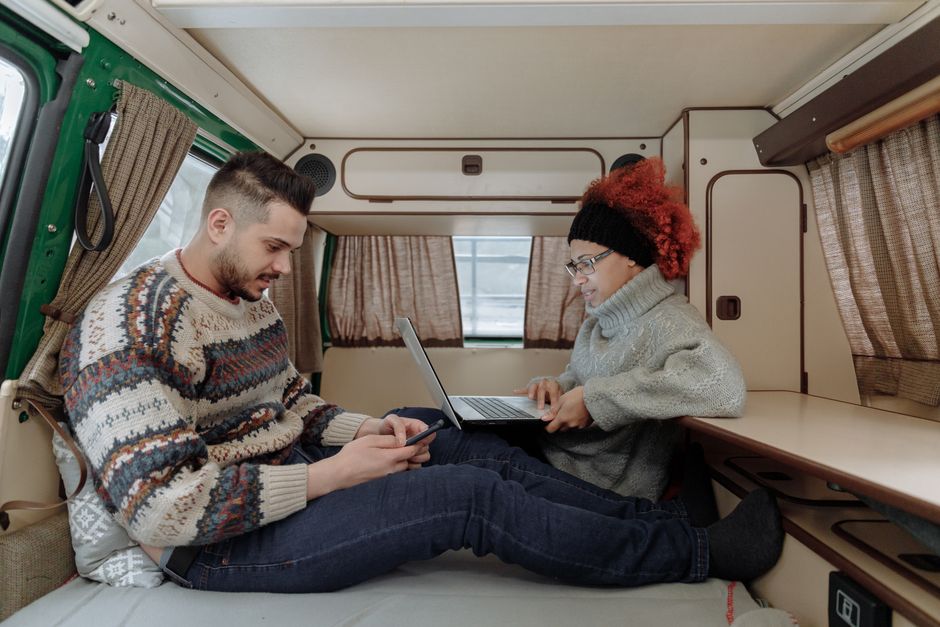
The Internet Problem: How to Stay Connected Off-Grid
Ask anyone who has tried remote work from a campervan and failed, and the answer is almost always the same: the internet let them down. A mobile hotspot works fine in a city. Drive 20 kilometers into the Bieszczady mountains or park on a quiet Mazurian lake shore and you will quickly discover what no signal really means for your quarterly report deadline.
This is why the technology you use for connectivity matters more than almost anything else. There are three realistic options in 2026:
- Mobile LTE/5G hotspot: Works well in populated areas, unreliable in rural zones, completely dead in remote forests or highlands.
- Local SIM roaming: Useful as a backup, but data caps and throttling make it unsuitable for video calls and large file transfers.
- Starlink satellite internet: 50 to 200 Mbps download speeds, ping under 50 milliseconds, works in forests, on mountains, by the sea. This is the only option that genuinely solves the remote work connectivity problem.
The Starlink Mini, which Nomad Camper includes in every rental at no extra cost, delivers consistent performance where LTE simply cannot reach. You can run a Zoom call at 4K from a forest near Szczecinek, upload a 2GB video file from a parking spot in the Tatra foothills, or join a client presentation from a Baltic beach at 8 AM. The antenna draws around 20 to 40 watts, which is manageable for any van with a proper solar setup.
Key insight: Connectivity is the single most critical factor for campervan remote work. Do not rent or buy a van that does not include a satellite internet solution if you plan to work from genuinely remote locations.
Power Management: Keeping Your Devices Running for Days
A reliable internet connection is useless if your battery dies at noon. Power management is the second pillar of successful campervan remote work, and it is an area where most standard campervans fall short.
A typical conversion van comes with a 100 to 200Ah AGM battery. That sounds like enough until you factor in your laptop (45 to 65W), a monitor (20 to 40W), the Starlink antenna (30W), a refrigerator running continuously (40 to 60W), and lighting. You are looking at 150 to 200W of continuous draw. A 100Ah AGM battery gives you maybe five or six hours before you are in trouble.
A serious off-grid work setup requires:
- Large LiFePO4 battery bank: Lithium iron phosphate holds more usable capacity, charges faster, and lasts ten times longer than AGM. 400Ah or more is the practical minimum for multi-day autonomy.
- Solar panels: 400 to 600W of roof-mounted panels keep the bank topped up during daylight hours, even on overcast days in northern Poland.
- MPPT charge controller and inverter: The Victron ecosystem, specifically the MultiPlus-II 3000W combined with a Victron MPPT, is the industry benchmark for efficiency and reliability.
- Shore power compatibility: For days when you park at a campsite, a 230V hookup connection lets you charge overnight at near-zero cost.
Nomad Camper's MAN TGE 3.140 runs a 405Ah LiFePO4 Energoblock battery bank paired with 500W of solar (305W fixed plus two 200W Volt panels) and a Victron MultiPlus-II 3000W inverter-charger. In practice, that translates to two to three full days of autonomous operation without any sun at all. Park under clear skies and the system is essentially self-sustaining indefinitely.

Setting Up a Productive Workspace Inside a Campervan
The physical workspace inside your van determines whether you can actually concentrate, or whether you spend the day hunched over a laptop on your bed, developing a neck problem and resenting the entire experience.
A good campervan workspace has four elements:
A Proper Table Setup
Fixed tables that cannot be adjusted to different heights are a problem for full-time work. The Lagun table system, which swings and adjusts, solves this. Combine it with rotating seats using a system like Mobiframe obrotnice, and you have a genuine desk-and-chair setup that rivals a small home office.
Ergonomic Seating
Van bench seats are not designed for eight-hour work days. Rotating front seats with an adjustable backrest are a significant upgrade. Some renters bring a small portable lumbar cushion as a backup.
Temperature Control
Nobody concentrates in a 35-degree van in August or a 2-degree van in November. The Dometic FreshLight 1400 provides both air conditioning and heating from a single unit, running off the van's battery bank. Truma D6E diesel heating covers the colder months with near-silent operation and a built-in hot water boiler.
Lighting and Screen Visibility
Park with your screen facing away from direct sunlight. Interior LED lighting, ideally warm and dimmable, reduces eye strain during evening work sessions. The Hella Luminato light bar integrated into the Intrak roof rail system in Nomad Camper's van handles this well.
Planning Your Route Around Your Work Schedule
One of the biggest mistakes first-time campervan workers make is treating the van like a standard holiday vehicle. You drive for six hours, arrive somewhere beautiful, and then realize you have no energy left to work and no idea whether the spot has usable satellite coverage (hint: with Starlink, it almost always does, but tree canopy can reduce speeds).
A smarter approach is to build your route around your work calendar, not the other way around.
- Move on Fridays or weekends: Drive to your next location when your workload is lightest. Arrive Saturday, settle in, start Monday fresh.
- Book two to four nights minimum per spot: Moving every day is exhausting and eats into productive hours. Three nights in one place gives you two full work days and one exploration day.
- Use offline maps for pre-planning: Apps like Maps.me or OsmAnd let you save areas for offline access. Check road quality for a vehicle with the dimensions of a MAN TGE before you commit to a forest track.
- Identify backup spots near each location: If your first choice turns out to be too shaded or too noisy, having a second option five kilometers away saves a lost morning.
Poland is genuinely well-suited for this lifestyle. Mazury offers flat terrain, thousands of quiet lake shores, and easy road access. Bieszczady gives you dramatic scenery with almost no tourist crowds outside July and August. The Baltic coast between Ustka and Leba has long stretches of forest parking right behind the dunes. And central Pomerania, where Szczecinek sits, is underrated: forests, lakes, and almost no other campervans competing for the same spots.
The Real Costs of Working Remotely from a Campervan
People often assume van life is cheap. It can be, but only if you plan it properly. Here is an honest breakdown of what a week of remote work from a campervan actually costs in Poland in 2026:
- Campervan rental: From 400 PLN per night (high season up to 600 PLN). A seven-night rental runs roughly 2,800 to 4,200 PLN.
- Fuel: The MAN TGE 3.140 diesel averages 10 to 12L per 100km on mixed roads. At roughly 7 PLN per liter, a 1,000km week costs around 700 to 840 PLN.
- Food: Cooking in the van is significantly cheaper than restaurants. Budget 50 to 80 PLN per person per day for groceries.
- Campsites: Completely optional if you free camp legally. When you do use a campsite, budget 50 to 120 PLN per night.
- Internet: Zero. Starlink is included in Nomad Camper rentals.
- Heating/cooling energy: Zero extra cost. Diesel heating draws from the van's tank, solar handles the rest.
Compare that to a week in a city: rent, utilities, restaurant lunches, and commuting costs. For many professionals, a working van trip costs less than staying home while delivering an experience that no city apartment can match.
What to Look for When Renting a Campervan for Remote Work
Not every campervan on the Polish rental market is suitable for serious remote work. Most are holiday vehicles designed for a week at a campsite with shore power. Before you book, run through this checklist:
- Internet solution: Does it include Starlink or a proven satellite option? A mobile hotspot is not sufficient for full-time work in remote locations.
- Battery capacity: Is it LiFePO4 with at least 300Ah usable? AGM batteries under 200Ah will leave you scrambling for a campsite hookup by day two.
- Solar panel output: At least 400W is the realistic minimum for multi-day autonomy in Polish weather.
- Inverter power: You need at least 1,500W pure sine wave to run a laptop, monitor, and other devices simultaneously without issues.
- Workspace ergonomics: Does the van have an adjustable table and rotating seats, or will you be working hunched over a fixed bench?
- Temperature control: Independent air conditioning and heating, not just a fan and a blanket.
- Road capability: If you want to reach genuinely quiet spots, you need a van that can handle unpaved forest roads without getting stuck. Check for all-terrain tires and ground clearance.
Nomad Camper's MAN TGE 3.140 rental meets every point on this list. It is, honestly, the only rental vehicle in Poland built specifically around the needs of someone who needs to work and travel at the same time, rather than just park at a campsite and watch Netflix.

Frequently Asked Questions
Can I really work full-time from a campervan with a reliable internet connection?
Yes, provided the van has satellite internet. Starlink Mini, included in Nomad Camper rentals, delivers 50 to 200 Mbps download speeds with sub-50ms ping in locations where LTE has no signal at all. Video calls, large file uploads, cloud-based work, all of it runs without issues. The key variable is finding a spot with open sky above you, which Starlink needs to connect to its satellite constellation.
How many days can the van run without plugging in anywhere?
With the 405Ah LiFePO4 setup and 500W solar in Nomad Camper's van, you get two to three days of full autonomy with no sun at all. Add any decent daylight and the solar panels continuously top up the battery bank, extending that indefinitely in practice. This means you can park in a remote forest for a week and never need a campsite hookup.
Is it legal to park and sleep in a campervan in Poland?
Overnight parking in a campervan on public roads is generally permitted in Poland outside of explicitly restricted areas. Forest Service roads and national park boundaries require more care. As a practical rule, quiet spots away from residential areas, with no explicit no-camping signs, are used regularly without issues. Nomad Camper's team can advise on specific regions and favorite spots around Mazury, Bieszczady, and the Baltic coast.
What is the minimum rental period at Nomad Camper?
Nomad Camper requires a minimum of 5 nights (7 nights over New Year), with pricing starting from 400 PLN per night. The security deposit is 5,000 PLN, returned within three business days after the vehicle is returned in good condition. Pickup is in Szczecinek, in the Zachodniopomorskie region, which is well-positioned for trips north to the Baltic, east to Mazury, or south to the Sudeten and Carpathian ranges.
Ready to Turn Your Office Into a Moving View
Working remotely from a campervan is not about escaping responsibility. It is about doing the same work you always do, but from a place that makes you actually want to get up in the morning. The technology exists. Starlink solves the internet problem. LiFePO4 batteries and solar solve the power problem. A well-designed van interior solves the workspace problem. What remains is simply deciding to do it.
The three things to take away from this guide: connectivity is everything, so choose a van with proven satellite internet; power autonomy determines your freedom, so check the battery and solar specs carefully; and your route should serve your work schedule, not compete with it.
Nomad Camper's MAN TGE 3.140 is built for exactly this. Starlink included. 405Ah lithium power. Climate control. A real workspace. And pickup from Szczecinek, ready for wherever your next project deadline takes you. Check availability and book your remote work campervan trip today.