
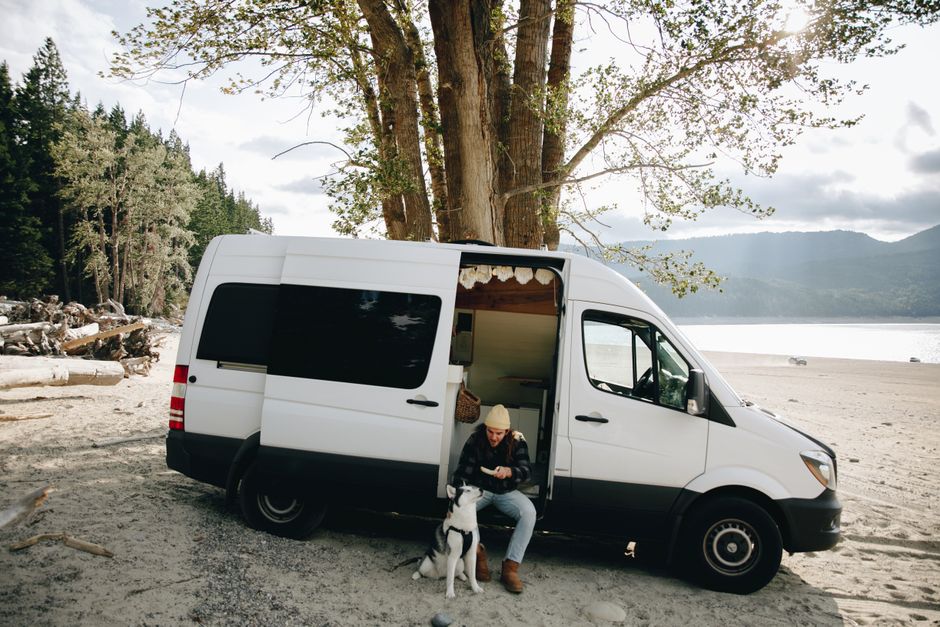
The campervan vs camping debate comes up every time someone starts planning a longer trip and realizes that pitching a tent in a field and driving a fully equipped motorhome are two entirely different experiences. Both have genuine appeal. Both have real drawbacks. And the choice between them shapes everything, from how much you spend per night to where you can actually sleep. This article breaks down the honest differences in comfort, cost, flexibility, and off-road capability, so you can decide which approach fits your next adventure. You'll also find out what a modern camper terenowy like the one offered by Nomad Camper actually includes, and why it changes the calculation for many travellers.
What Does Campervan vs Camping Actually Mean?
At first glance, the question seems obvious. Camping means a tent, a sleeping bag, and a patch of ground. A campervan is a vehicle with a bed inside. But the real distinction runs much deeper than that, because modern campervans have become self-contained living spaces, while traditional camping has also evolved well beyond the basic bivouac.
When people search for kamper vs kemping, they're often comparing two travel philosophies. Traditional camping ties you to designated campsites with fixed infrastructure: electricity hookups, shared bathrooms, a reception desk that closes at 9pm. A campervan, especially a self-sufficient off-grid model, removes most of those constraints. You decide where to stop, when to leave, and how long to stay.
According to data from the European Caravan Federation (2025), the number of registered motorhomes and campervans in Europe exceeded 3.5 million units, with Poland showing one of the fastest growth rates on the continent at approximately 18% year-on-year. That growth reflects a shift in how people think about travel, not just a fashion for vehicles.
- Traditional camping requires a pre-booked pitch at a designated site in most countries
- Campervans can use official campsites, motorhome aires, or wild camping spots depending on local rules
- A fully off-grid campervan needs no external hookup for power, water, or heating
- Tent camping offers lower upfront cost but higher dependency on infrastructure and weather
Kluczowa informacja: The core difference is not just shelter, it is autonomy. A campervan moves your home with you. A tent pins you to wherever you've managed to book a pitch.
Freedom and Flexibility: Who Wins?
Honestly, this one is not even close. A campervan wins on flexibility by a significant margin. With a tent, you plan your route around campsite availability. During peak season in popular destinations like Croatia, Norway, or the Polish Mazury lake district, securing a pitch weeks in advance is standard practice. Change your mind on day three? You lose your booking and scramble for alternatives.
A self-contained campervan changes that completely. You can follow the weather, follow a recommendation from someone you met at a fuel station, or simply drive until a view convinces you to stop. This kind of spontaneous travel is what most people actually want when they imagine a road trip, but it requires the vehicle to be genuinely self-sufficient.
For a podróż kamperem po Polsce or across Europe, the ability to park in a forest clearing, a mountain pass, or beside a river without booking anything in advance transforms the experience. That said, wild camping rules vary significantly by country. Norway permits it broadly under the Allemannsretten principle. Poland allows dispersed camping in state forests under regulated conditions. France and Germany have stricter rules for roadside parking.
- Campervans allow last-minute route changes without financial penalties
- Wild camping is legal or tolerated in many European destinations with a self-contained vehicle
- Tent campers are largely bound to designated sites with fixed check-in and check-out times
- Bad weather is manageable in a campervan. In a tent, it can end your trip early.
Comfort on the Road: Campervan Features vs Tent Life
Let's be direct. Sleeping in a tent is uncomfortable for many people. The ground is hard, the weather intrudes, morning condensation soaks your gear, and every trip to the bathroom at 3am is an expedition. Some people love that rawness. Others tolerate it for the cost saving and end up exhausted by day four.
A well-equipped campervan eliminates those problems entirely. The MAN TGE 3.140 operated by Nomad Camper includes a fixed 140x200cm bed with a Froli spring system, a Dometic FreshLight 1400 climate unit that handles both heating and cooling, and a Truma D6E diesel heater with a hot water boiler. You wake up at a consistent temperature, in a proper bed, with a hot shower available if you want one.
What a Modern Campervan Actually Includes
- Fixed double bed (140x200cm) with ergonomic Froli spring system
- Dometic FreshLight 1400 for air conditioning and heating
- Truma D6E diesel heater with hot water boiler
- Dometic RC10.4T 70L fridge, Solgaz gas cooker and grill
- Dometic CT4110 cassette toilet with Maxxfan ventilation
- Interior finished in poplar plywood with veneer, Lagun folding table, Mobiframe swivel seats
Tent camping requires you to pack and carry every item you need for comfort. A campervan keeps everything in one place, always ready, always dry. For families, couples travelling for more than a weekend, or anyone planning a wynajem kampera na miesiąc or long-distance European journey, the comfort difference is substantial.

Cost Comparison: Campervan Rental vs Traditional Camping
This is where the comparison gets more nuanced. Traditional camping appears cheaper on paper. A campsite pitch in Poland costs between 50 and 120 PLN per night depending on location and season. A tent, sleeping bags, and cooking gear represent a one-time purchase. So the nightly cost looks very low.
But add up what you're not getting. No shower without a token. No kitchen without queuing. No power without a hookup fee. No weather protection. And if you're travelling across Europe, booking multiple campsites, eating out more because cooking on a camp stove is tedious, and replacing wet or damaged gear, the actual cost rises quickly.
The wynajem kampera cena at Nomad Camper starts from 400 PLN per night in low season, rising to 600 PLN per night in peak season. That price includes Starlink internet, all utilities, GPS tracking, and a fully equipped kitchen and bathroom. A deposit of 5,000 PLN is returned within three business days after the rental.
According to ADAC research (2024), a family of two adults travelling by motorhome across Europe for two weeks spends approximately 15-20% less on total trip costs compared to a hotel-based itinerary covering the same destinations, once meals, transport, and accommodation are calculated together. Camping with a tent falls somewhere between the two depending on location and season.
Real Cost Breakdown Per Day
- Tent camping (Poland, high season): 80 PLN pitch + 40 PLN food prep overhead + 20 PLN misc = ~140 PLN
- Campervan rental (self-contained): 500-600 PLN includes kitchen, bathroom, internet, bed, climate control
- Hotel mid-range (Poland, peak): 350-500 PLN room only, meals extra, no outdoor access
- Campervan wild camping: eliminates nightly pitch fees entirely
For a wynajem kampera na tydzień, the all-in cost of the campervan becomes even more competitive once you factor in zero campsite fees, cooking all meals in a proper kitchen, and avoiding restaurant markups at tourist-heavy destinations. Check the full wynajem kampera options and availability on our fleet page.
Off-Road Access and Remote Destinations
This is where a standard campervan or traditional tent camping both hit a wall, and where a purpose-built kamper terenowy creates a completely different category of travel.
Most rental campervans are built on standard van platforms with low ground clearance and road-only tyres. They can reach official campsites, but gravel forest roads, mountain passes, or beach approaches with soft sand are either off-limits or genuinely risky. A tent gives you more flexibility on foot, but you still need to drive to a trailhead and park somewhere accessible.
The Nomad Camper MAN TGE runs on a reinforced platform with pneumatic suspension, Intrak off-road roll cage with Hella Luminato lighting, and ARB Tred Pro traction boards for recovery situations. It reaches places a standard campervan or rented car simply cannot. That means sleeping beside a mountain lake in the Bieszczady, reaching a secluded Baltic beach approach, or driving logging roads in the Masurian forest without any of the usual risk calculations.
- Standard tent camping: access limited to where your car can go, then where you can carry gear
- Standard campervan: road surfaces only, requires official parking or camp pitch
- kamper z oponami AT (napęd przedni) off-road: genuine cross-country capability with full self-sufficiency once parked
For anyone planning a podróż kamperem po Norwegii, the Scottish Highlands, or remote Polish forests, off-road capability is not a bonus feature. It is the feature that makes the trip possible. You can explore the mapa kamperowa to find off-the-beaten-path overnight spots across Poland that are only reachable with a capable vehicle.
Remote Work and Digital Nomad Life
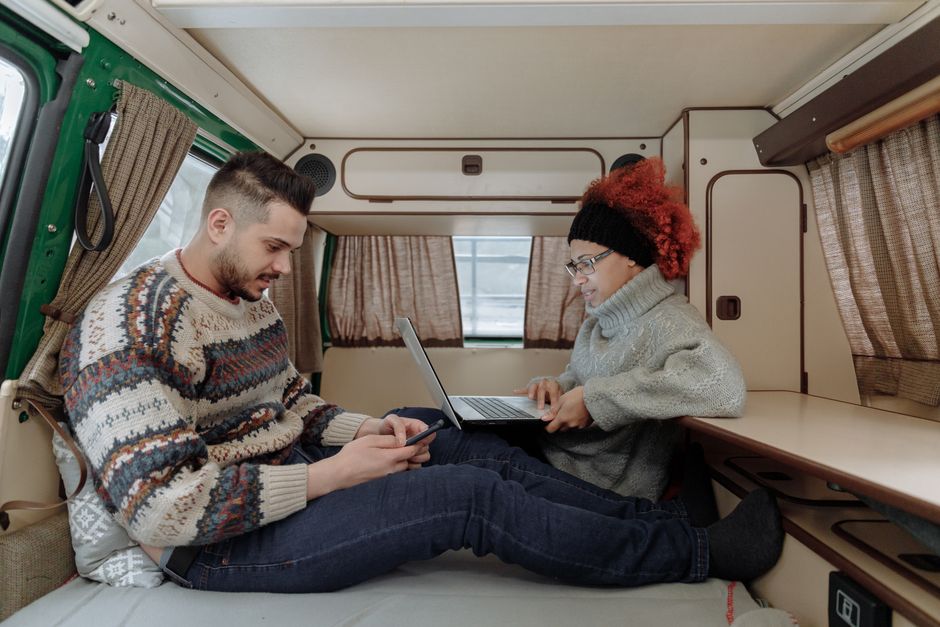
Tent camping and remote work are essentially incompatible. Your laptop battery lasts four hours. Your mobile signal disappears in the valleys where the best campsites are. Rain makes outdoor working impossible, and most campsite common rooms close at 10pm.
A self-contained campervan with proper energy and internet systems changes that picture entirely. The Nomad Camper setup includes Starlink Mini delivering 50-200 Mbps download speeds with ping below 50ms, powered by a 405Ah LiFePO4 Energoblock battery bank, 500W of solar panels (305W fixed plus two 200W Volt portable panels), and a Victron MultiPlus-II 3000W inverter with MPPT charge controller. That system runs for 2-3 days without any sunlight at all.
Industry estimates from the Remote Work Association (2025) suggest that approximately 12% of European remote workers now take at least one extended work trip per year from a mobile base, a figure that has doubled since 2022. The praca zdalna z kampera model works because the technology now exists to make it reliable.
- Starlink Mini: 50-200 Mbps, ping under 50ms, included in rental price
- 405Ah LiFePO4: enough capacity for laptop, screens, coffee maker, and climate control simultaneously
- 500W solar + Victron MPPT: recharges the battery bank even on partially cloudy days
- Swivel seats and Lagun folding table create a proper desk setup inside the vehicle
If you need to stay connected while travelling, the choice between kamper vs kemping is already made for you. A tent offers none of this. A standard campervan with a hookup-dependent system offers it only when you're plugged into a campsite. An off-grid campervan with Starlink gives you broadband in the middle of a national park.
Which Option Is Right for You?
The honest answer depends on what you value most during a trip. Neither option is objectively better. But the match between travel style and choice is important enough that getting it wrong ruins the experience.
Choose Traditional Camping If:
- You genuinely enjoy the physical experience of outdoor sleeping
- Your budget is very tight and you own all the gear already
- You're staying in one location for an extended period
- Your destination has excellent campsite infrastructure
- You prefer hiking from a fixed base rather than driving between locations
Choose a Campervan Rental If:
- You want to cover multiple destinations without rebooking accommodation each time
- You need to work reliably during the trip
- You're travelling as a couple or with one other adult and want genuine comfort
- Weather reliability matters to your enjoyment
- You want access to remote locations without the discomfort of tent camping
- You're planning a podróż kamperem po Europie covering several countries
For most people weighing kamper vs kemping for a week or longer, the campervan delivers more of what they actually wanted when they booked the trip: freedom, comfort, flexibility, and the ability to change plans without stress. A kamper na weekend rental also makes sense for shorter escapes where a tent would feel like too much setup for too little payoff.
Frequently Asked Questions
Is renting a campervan more expensive than camping in a tent?
Per night, yes. But the total trip cost is often comparable once you account for campsite fees, eating out more frequently, hookup charges, and the hidden costs of tent camping gear degradation. For trips over five days, a self-contained campervan with cooking facilities often costs less than the equivalent hotel or glamping alternative, and provides significantly more freedom than a campsite pitch.
Can I use a campervan without staying on official campsites?
Yes, especially with a self-contained off-grid vehicle. Poland allows dispersed camping in designated state forest areas. Many European countries permit overnight parking in lay-bys or motorhome aires. With a fully off-grid campervan like the Nomad Camper, you carry your own power, water, and waste management, which makes stopping outside official sites genuinely practical.
What is the minimum rental period for a campervan?
At Nomad Camper, the minimum rental period is five nights (seven over New Year). Weekly and monthly bookings are available and often offer better value per night. Contact us at info@nomadcamper.pl or +48 666 607 545 for custom availability.
Do I need a special driving licence to rent a campervan?
The Nomad Camper MAN TGE 3.140 falls within the standard category B driving licence limits in Poland, meaning any driver with a regular car licence can operate it legally. No special licence or prior motorhome experience is required, though we recommend reading the vehicle briefing document before departure.
The Bottom Line
The kamper vs kemping comparison comes down to one question: how much does friction cost you during a trip? Tent camping introduces friction constantly. Unpacking in the rain, cold mornings, dead phone batteries, campsite queues. A self-contained campervan removes most of that friction and replaces it with the kind of freedom that most people were imagining when they started planning the trip in the first place. You sleep in a real bed. You have hot coffee before anyone else on the site is awake. You leave when you want. You stop where you want. And if you need to send a report to a client from a forest clearing in the Bieszczady, your Starlink handles it at 150 Mbps without complaint. That is the real difference. Not just shelter versus a vehicle, but one travel style that works for you and one that you spend the trip working around.
Ready to see what a week without campsite bookings or weather anxiety actually feels like? Explore our wynajem kampera terenowego options and check live availability. Then book your campervan rental online and start planning a route that doesn't depend on anyone else's schedule.